| Notes |
- Composite Record of James Matthews Hoover (1872-1935)
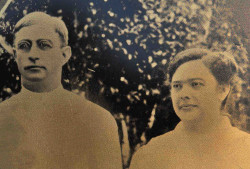
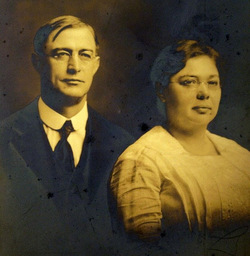
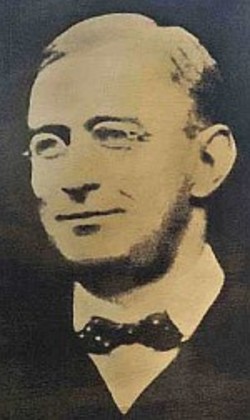
1872, 26 Aug, James Matthews Hoover born at Greenvillage, Franklin County, Pennsylvania, to John H. and Emily (Matthews) Hoover.
Residence at Greenvillage in the house of the Methodist minister Wesley Howe.
James M. Hoover's father, of a German Baptist (Dunkard) background, was a shoemaker, operating at home. His mother, Emily Matthews, came from Leesburg, Cumberland County, PA.
1878-1886 James attended the Greenvillage Public elementary School.
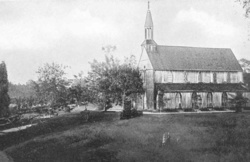
Attendance of the Greenvillage Methodist Church (no longer standing but cemetery remains).
1887, James M. Hoover experienced the Grace of God, was converted as a fifteen-year-old and joined the Church.
ca 1887-1890 Secondary Student at the Shippensburg Normal School (now Shippensburg University)
Organisation of Young Men's Christian Association
1890, James M. Hoover and his family living at Frederick and King Street, Chambersburg, PA.
Attendance at the King Street United Brethren in Christ congregation in Chambersburg, PA.
Then, attendance and membership of St. Paul's United Brethren in Christ Church, Chambersburg, PA.
James M. Hoover taught Sunday School and elementary school in Chambersburg, both African-American and white students.
1899, Commission of the Methodist Church to teach school at Penang, Malaysia. Travel to Penang in 1899.
1990-1902, 1,118 immigrants from the Chinese province of Fujian arrive to settle the Rajang Delta in Sarawak. They arrive in three shipments, led by the Christian scholar, Wong Nai Siong (1854-1932).
1903, James M. Hoover commissioned, in Singapore, to assist the Fuzhou colonists in the Rajang River delta of Sarawak.
1903, First trip to Sarawak.
1904, marriage with Mary Young in Penang, Malaysia.
James M. Hoover becomes the representative to the British Colonial Government of the Fuzhou colonists.
Major work with saw milling, setting up rice farms and mill, improving roads, introducing bicycles, electricity, an ice plant and more.
Above all, James M. Hoover, worked with local Christian assemblies, facilitating their organisation, teaching, and interaction as Christian brothers and sisters.
Extensive travels within Sarawak, and possibilities of more colonisation of Chinese settlers.
1936, Serious bout of malaria.
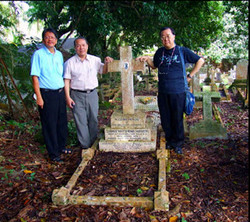
1935, 11 Feb, James M. Hoover died at Kuching, at the British hospital. Internment at the nearby St. Thomas Anglican cemetery.
.
- Excerpt from C. F. Berkheimer, Harrisburg District History
Our present missionaries in Sarawak, the Charles Roots, are now building on the foundation laid by "Jim" Hoover of Chambersburg, another of the greats in Methodist missionary history.
He was a layman, a volunteer, and an extraordinary servant of the Master among the so-called head-hunters in Borneo. He organized Chinese colonists in Sarawak into classes, taught them agriculture, and led them to Christ. He died and is buried there, where he literally gave his life. Bishop Titus Lowe, in charge of the work in Malaysia, told me that when Jim Hoover was buried it was in the rainy season and his body was lowered into its grave while it was overflowing with water.
.
- SIBU:
Stories and photos by PHILIP HII
This town is not done with honouring its much loved and revered missionary, the Rev James Matthew Hoover.
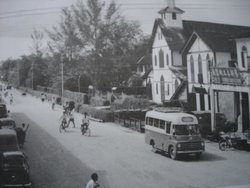
It already has a park dedicated to his memory, but tomorrow, Sarawak Chief Minister Tan Sri Abdul Taib Mahmud will declare open the impressive RM20mil Masland Methodist Church Complex, also called the Hoover Project, on Island Road.
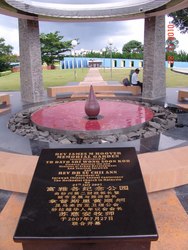
Impressive: The funnel at the Hoover memorial.
Together with Chinese missionary Rev Wong Nai Siong, Hoover?s place in Sibu?s history is linked to his role in helping the Foochows, who were instrumental in the growth of the settlement in the early 1900s.
It was Wong, also honoured as one of the town?s founding fathers, who successfully negotiated with the second white Rajah of Sarawak, Sir Charles Brooke, to bring in Chinese immigrants from Fuzhou province to open up the Rajang Delta for agriculture.
Hoover, an American, was sent to Sibu to teach and lead this group of mostly Christian migrants.
Both of them are remembered today with a memorial garden each at the place where they first landed, Sungai Merah, 5km from Sibu town.
The Wong Nai Siong Memorial is part of the Sungai Merah Heritage Walk constructed in 2001 to celebrate the centennial of the arrival of the first batch of Foochow immigrants.
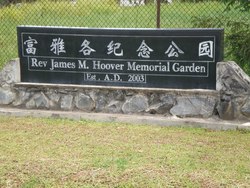
The Rev James Matthew Hoover Memorial Garden was opened in 2007 by Datuk Seri Wong Soon Koh, Sarawak?s Second Finance Minister, and Rev Dr Su Chii Ann, president of the Sarawak Chinese Annual Conference of the Methodist Church in Malaysia.
It is the only joint project by a local council and the Methodist Church in Malaysia,? said Daniel Ngieng, Sibu Municipal Council (SMC) deputy chairman.
He explained that the 1.25ha site belonged to the state, and designated as a public park by SMC.
We are aware that Rev Hoover contributed tremendously to the early stages of Sibu?s development. ?So when the church proposed building a memorial park for him, we eagerly played our part in tribute to this outstanding missionary and his wife,? he added.
The Hoover Project comprises the church, a multi-purpose building and an open space called Hoover Square. Construction work began in December 2006.
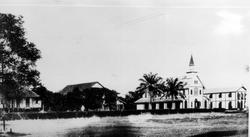
Hoover built the original Methodist Church in 1905. It was reconstructed to meet the needs of a growing community and renamed as Masland Methodist Church in 1925, in memory of an American widow who donated US$5,000 towards the construction costs.
The interior church?s interior has been massively renovated and installed with a new audio-visual system. It can accommodate about 1,700 people.
The L-shaped, multi-purpose building has 2½ storeys for its car park, three large halls for fellowship and conferences, administrative offices and the Methodist Kindergarten and Methodist Primary School located at the back.
The kindergarten and primary school combined have 1,800 pupils. There are also 10 guest rooms for visiting pastors, outstation members and Christian travellers.
Hoover Square, which can accommodate 1,000 people, is intended for concerts, dances and workshops.
The complex is not fenced, a friendly gesture to make it accessible to the public.
Masland Methodist Church, which employs six pastors and a staff of 15, has 5,000 members who donated RM13mil towards the construction and renovation costs.
The remaining RM7mil was borrowed from the Sarawak Chinese Methodist Annual Conference of the Methodist Church in Malaysia and will be repaid in instalments.
.
- James Matthew Hoover Memorial Garden at Sungei Merah Town.
In 1904, he was appointed by Rajah Charles Brooke of Sarawak as the ?head of all the Sarawak Foochows?, a position he held until his death in 1935 at the age of 63.
He discharged his responsibilities as a missionary and political leader well. In fact, it is fitting to call him the father of development of the Foochow community in Sibu as his emphasis on church establishment, education, social concern and economic development yielded far reaching results.
According to the memorial, during his lifetime, he established 41 churches and 40 schools along the Rajang Basin in Sarawak where in 1904; he married Ethel Mary Young in Penang.
In addition, he created history and modernised Sibu by pioneering a number of ?firsts? in Sibu, including planting the first rubber seedlings, rice huller, girls? school, agriculture school, bicycle, ice-making machine, circular saw and wireless telegraph machine.
To commemorate his astounding contribution to the Foochow community in Sibu during those years, Hoover Memorial Garden was built in 2003 at Sungai Merah Town.
It was officiated by the then Minister of Urban Development Tourism Dato Sri Wong Soon Koh in 2007.
.
- HE WAS AFRAID BUT HE KEPT ON
True Stories of Missionaries, Friendship Press, NY, 1948
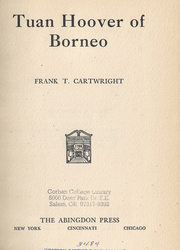
by FRANK T. CARTWRIQHT
WHEN James Hoover was young, Borneo to him was just a spot on the map, representing an island, as it probably is to you. If he had ever heard of the people who lived there, it was likely in the ditty about the "Wild Man of Borneo." He did not dream that some day those "wild men" were to give him one of the most frightening experiences of his life.
James Hoover was twenty-seven years old when he set out to be a missionary in Malaya, that long peninsula stretching southward from the coast of Asia. He went to teach in a boys' school in Penang. There he began to hear stories about the near-by island of Borneo stories that interested and excited him. He started to read all that he could find about Borneo.
He learned that the "wild men of Borneo" were Dyaks. They were fierce fighters and head-hunters who were continually at war with one another. Work did not appeal to them, and they farmed in a very crude way.
Hoover learned also of the "white Rajah," Charles Brooke, who ruled in the part of Borneo called Sarawak. The story of how a white man came to devote his life to ruling Sarawak and trying to bring peace and order there was one
that fascinated him.
But the story that Hoover liked best of all was of the founding of a colony of Chinese Christians in Sarawak. The "white Rajah" had wanted for hjs country, men who would farm the land. He had struck upon the idea of asking Chinese to come from their crowded country and settle in Sarawak. He had offered steamer fare, free land, and food until the first crop was harvested.
The people who had answered his invitation were Christians from Foochow, China, where there was a flourishing church. They set out like the Pilgrims of old, and after many trials they reached Sarawak. There they settled in the fertile valley of Rejang to do agricultural work.
The first years in the new land were difficult for the settlers. They were homesick; the land and its ways were strange to them. The Dyaks were unfriendly and sometimes attacked them. Strange diseases affected them. Their numbers were growing less all the time. In their misery they asked that a missionary be sent to them. In Malaya, Hoover heard their call. He not only heard, he answered and went to them to be their missionary.
With his boundless energy and his undefeatable Christian faith, Hoover brought new spirit to the Chinese. They began to succeed where before they had steadily failed. He persuaded them to try crops new to them but suited to the
climate and soil of Sarawak rubber, pepper, coffee. The people of each scattered settlement were encouraged to establish at the center a building that would serve as both
church and school and to endow it with a plot of land on which by united labor they would plant rubber trees that would help to support the pastor-teacher. He trained the more promising boys until they were able to serve as lay preachers, and the best of these were sent away for theological training.
All the time he was befriending the Dyaks, even though he never had the time nor the resources to establish schools and churches for them. They knew that he was friendly to them and did not hesitate to come to him. It was shortly after James Hoover had married Mary, the daughter of a missionary, that the most frightening experience of his life occurred.
This is how Hoover described the happening to a friend of his:
"Mary and I had been married only a short time, and the life in Borneo was strange for her. In many ways it was terrifying. She knew and liked the Chinese, but they themselves were afraid of the nearly naked Dyaks, who would come to town in groups, heavily tattooed and carrying head-knives, shields, and spears. We had scarcely organized our school and congregation when an intertribal war broke out in the upriver regions, and some Dyaks friendly to the 'white Rajah' came up the creek in their war canoes and anchored at the bridge near our home. After they had eaten a supper of rice, sweet potatoes, and a snake they had broiled, the headman came to demand that they be allowed to sleep in the large room of our house. What could we say? Not a thing except a word of welcome. There were no policemen for protection. We were hundreds of miles from any effective force of white men. The Chinese of the village a little way downstream were as afraid as we were.
"They moved in, and we went into our inner rooms, which had only flimsy doors with no locks on them. We talked and, yes, we prayed an extra prayer because we were nervous. And the next chapter was even worse, because they decided to rehearse for the battle they expected the next day. First one and then another warrior would rush out into the center of the room, brandishing his spear, leaping and howling his defiance. As if an enemy were in front of him, he would swing his shield before his body and wield his heavy knife as though his enemy's body were being carved into bits. Each dancer grew more wild, until we actually feared that a frenzy would drive them to attack us. We could hear even the little sounds, the panting breath as well as the shrieked defiance. And we could see everything because the cracks were almost as wide as our eyes! I think that long night of fear was our most terrifying experience.
"But Mary lulled 'em! She suggested that we open our little folding organ, and that really got them. Not one had ever seen a 'singing' box before, so they crowded around to watch and listen as she played. Soon they sat on the floor and fell asleep. It was truly a laughable ending to what we feared would be a tragedy.''
Hoover reported that their guests stayed a week and were put to sleep with singing every night.
With his wife as almost his only missionary aide, he spread churches and schools throughout the entire valley. In later years, he brought from the United States, as gifts of Christian friends, a small electric light plant and a power-driven sawmill An ice plant was established for the city, which soon grew where the first settlement was made. All of these projects were started by the missionary but immediately turned over to groups of Christian Chinese, so that the economic life of the whole region was steadily bettered.
A radio station was set up, and Hoover was the "expert."
Meanwhile, Mrs. Hoover started a primary school for the girls and later a secondary one where numbers of girls were trained for higher education or for the malting of good homes. Mary Hoover from the very beginning insisted that homemaking was one of the "musts" in the curriculum in Sarawak, and it was not a matter for wonder that she found herself almost besieged by the educated Chinese young men who wanted her to help arrange betrothals with her schoolgirls.
With no children of their own, Tuan Hoover (as the Malays called the missionary) and his wife stretched their affection to cover literally hundreds, even thousands, of Chinese in that region. Each six or seven years they would spend a brief furlough in the United States, sometimes studying, more often going up and down the land, telling of their work and shrewdly seeking constructive gifts to build a better community life on Borneo.
Years piled up. Honors came to them both. Charles Vyner Brooke, the third rajah of Sarawak, esteemed the elderly missionary, whom his father, Rajah Charles Brooke, had appointed in 1904 as 'protector of the Sarawak Foochows/* The Hoovers were frequent guests in the astana, or palace, of the rajah in Kuching, the capital.
In February of 1935, Hoover took seriously ill while on a boat from Kuching to Sibu, his home city. In Sibu, the doctor advised that Hoover be taken back to Kuching, where there was a hospital and adequate nursing. No boat was due to go back to Kuching for a week. When the rajah's representative in Sibu learned of the grave condition of his friend, he ordered steam in the boilers of the government launch and insisted that it make a special trip to take the sick man back to Kuching. Burning with fever, pitiably weak, Hoover was carried to the little cabin of the launch, protesting against leaving his work.
Two days later, Hoover was dead, malignant malaria having taken him off. The rajah ordered all schools and government offices closed in honor of one of Sarawak's reat men. The bright-colored flag was half-masted throughout the little protectorate. Chinese men and women wept openly and unashamed because their great friend had died.
But a series of clean and modern communities existed up and down the Rejang River because he had lived. And there were scores of schools and self-supporting churches with several thousand Christian church members as a living monument to one who, often in danger and sometimes afraid, never even faltered in his following of the way that he believed to be the way of Christ.
|
 Rainham Builders
 1872 - 1935 (62 years)