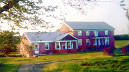
 Rainham Builders

 Conestoga Valley
Matches 1 to 14 of 14 » Thumbnails Only » Slide Show
| # | Thumb | Description | Linked to |
|---|---|---|---|
| 1 | 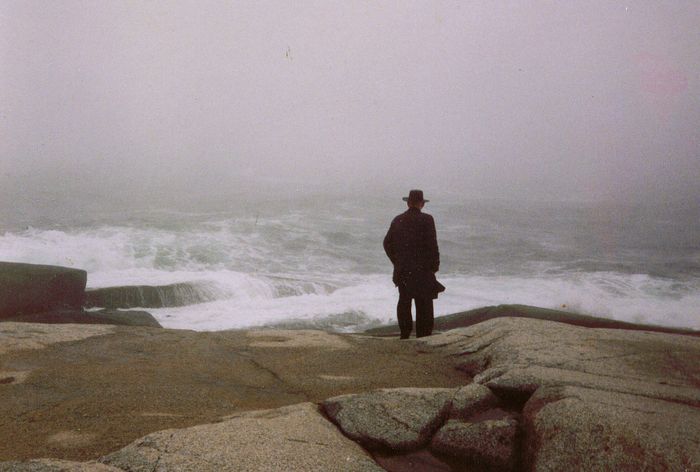 | A Late Fall Storm at Lake Erie, Rainham Township, ca 1998 Anson Hoover stands on the rocks along Lake Erie, not far from where his Hoover ancestors lie buried in the Rainham Mennonite Cemetery along the Lake. | |
| 2 | 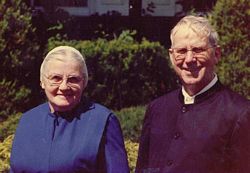 | Anson and Sarah Hoover Photo taken by Victor Eicker, on the occasion of their daughter Velina's wedding, in 1989. | |
| 3 | 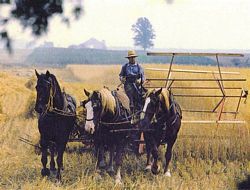 | Anson on the Binder, ca 1975 Anson with Bess, Pearl and Belle, bindering oats (Orvie Wideman farm visible in the distance). Anson greatly enjoyed his horses, especially if they pranced along with grace and style. We usually kept around a dozen or more horses, both heavy teams and drivers, since we did not use a tractor or car while living in the Conestoga River valley. | |
| 4 | 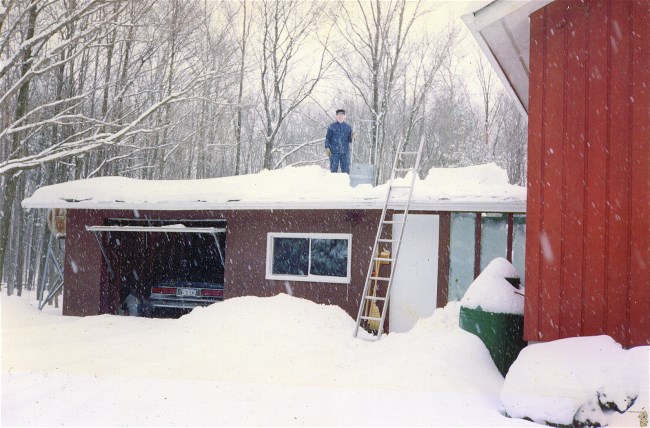 | Carthage, Ontario From 1985 to 2005 Anson and Sarah Hoover lived in a small place, just south of Carthage, Ontario. In this case Anson was shovelling snow off the roof after a particularly snowy time. | |
| 5 | 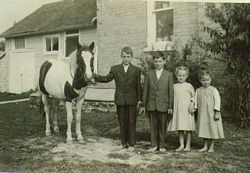 | Hoover Children, Wellesley Township Cleason, David, Nancy and Velina Hoover with their pony, on a Lord's Day morning, ca 1956 | |
| 6 | 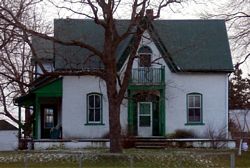 | Hoover Farm at Hawkesville In March 1919 Menno and Leah Hoover moved to a new farm near Hawkesville, in the Conestoga River valley of Ontario. Here they became part of new Wellesley Mennonite congregation, led by Daniel Brubacher, Enoch Horst and David W. Martin. Later Menno became instrumental in founding the Orthodox Mennonite Church. | |
| 7 | 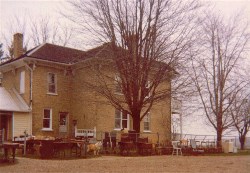 | Hoover Farm Auction Sale, 1978 In the spring of 1978 Anson and Sarah sold their farm in Wellesley Township, in order to move to another farm in Elma Township, Perth County. One mile east of Atwood, Ontario. Before the crowd gathered their farm dog, Sport, stood on the sidewalk, wondering what it all meant. | |
| 8 | 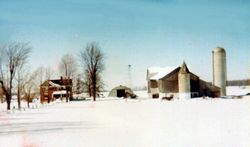 | Hoover Farm, Elma Township Hoover Farm, Elma Township In 1978 Anson and Sarah Hoover, with their youngest children, moved to a farm east of Atwood, Ontario. Here they belonged to the Hesson Conservative Mennonite Church. | |
| 9 | 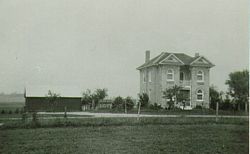 | Hoover Farm, Wellesley Township Anson and Sarah Hoover's farm east of Linwood in the early 1950. Anson liked to plant trees and by the 1980s, when they sold the farm, beautiful trees stood all around. | |
| 10 | 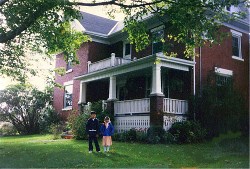 | Hoover House in Elma Township Hoover House in Elma Township Christopher and Graciela Hoover from Costa Rica visiting what had been their grandparents' place near Atwood, in 1993. Sarah Hoover from Atwood, Ontario, stands here, just after the Hoover Reunion in 1979. | |
| 11 | 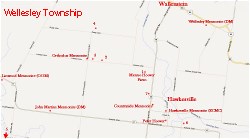 | Menno and Leah Hoover's Places around the Conestoga River When the Hoovers settled near Hawkesville, in 1919, they bought a farm northwest of Hawkesville, Number 1 in this map. 1. Menno and Leah raised their children in this farm, later passed on to their daughter Mary and her husband Isaac Bauman. 2. For a while Menno and Leah lived in this farm, but they also passed it on to their son Amos and his wife Rebecca (Martin) Hoover. 3. Menno and Leah lived with their daughter Rebecca with her husband Daniel Bauman for while. 4. Menno bought this farm and divided it between his sons. A large part of it he planted in timber. 5. Near Crosshill Menno bought a beautiful sugar bush. Later he sold it to an Old Order Mennonite man, Elam Burkhart. 6. For some time Menno and Leah owned the historic Crystal Spring Farm along the Conestoga River, east of Hawkesville. This is where John W. Martin set up and owned a woollen mill. The building, with its dams and mill race still stood until recent years. Menno and Leah sold this place to deacon Samuel and Hannah (Martin) Horst. 7. Menno and Leah reserved one part of their property near Hawkesville. Here they built up a new farm, with new buildings. Their son Tilman with his wife Maryanne (Bowman) Hoover started farming here, while Menno built a cosy retirement home (a "Daadihaus"), where their daughter Saloma lived as well. Menno and Leah are both buried in the Orthodox Mennonite Cemetery nearby (visible on this map). | |
| 12 | 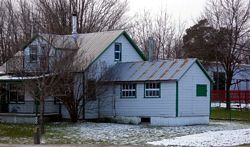 | Menno and Leah's "Daadihaus" After passing their farm at Hawkesville to their daughter Mary and her husband Isaac Bauman, Menno and Leah established a smaller farm just out of Hawkesville. Their youngest son, Tilman, farmed here and Menno and Leah lived for many years in this small house (in the foreground), with their daughter Saloma. Menno had a great interest in planting trees, taking care of a woodlot, and cutting timber from carefully selected trees. He bought two farms, one two miles to the northwest (north of the Redhill School), and one near Crosshill, a beautiful sugar bush. From local authorities he obtained permission to plant a shelter belt along what is now Herrgott Road between Hawkesville and Wallenstein, Ontario. | |
| 13 | 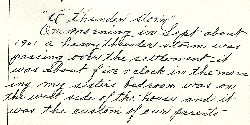 | Menno Hoover's Autobiography Unlike most other Anabaptists of his time, Menno Hoover wrote his story in vivid detail. He kept on writing, with a beautiful Victorian hand, even after he lost his sight in his latter years (he died in his 94'th year). Thanks to a vision granted to him by the Lord in 1918, Menno chose to walk on the narrow way, leaving his beloved home in Rainham Township behind, in order to find a more serious and godly fellowship among the nonconformed Anabaptists of the Grand River Valley. For this, we (his descendants) are still deeply grateful. | |
| 14 | 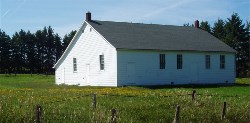 | Orthodox Mennonite Meetinghouse, Wellesley Twp Anson and Sarah Hoover took part in the first Orthodox Mennonite congregation, east of Linwood, from its birth in the early 1950s to 1976. This building, no longer used, was built on a lot bought from Daniel Bearinger, in 1962. |