| Notes |
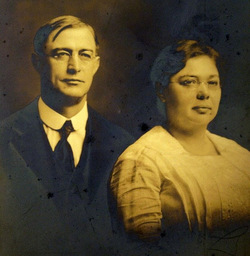
- Composite Record of Mary Rebecca Young (1883-1962)
1883, Mary Rebecca Young, born to Walter Reginald and Amelia Japonica (Towers) Young.
1892, Walter Reginald Young died.
ca 1895, Amelia Japonica Towers married again to George Frederick Pykett, missionary in Penang, Malaysia.
1902, Mary Young Hoover first visited Sarawak.
1904, March, marriage in Penang, Malaysia, with James M. Hoover, missionary of Sarawak.
1904, April, James and Mary (Young) Hoover arrived at Sarawak and began house-keeping at the Sg Merah settlement in the Rajang Delt.
1905, James and Mary (Young) Hoover, moved into the town of Sibu.
1913 Mary Young Hoover founded the Yuk Ing Girl's School in Sibu.
1930 Mary Young Hoover founded a girl's secondary school in Sibu.
1935, 11 Feb, James M. Hoover died in Kuching from malaria.
1936, Mary Young Hoover moved to Singapore.
1946, 15 June, Mary Young Hoover returned to Sibu in Sarawak to resume her guidance of the Yuk Ing School.
1947, Mary Young Hoover returned to Singapore, and not long afterwards, she moved to Perth, Australia, where she lived with her brother, Robert Guy Young.
Altogether, Mary Young Hoover spent 34 years in Sarawak.
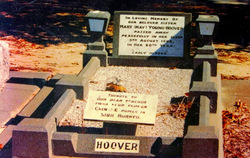
1962, 4 Aug, Mary Rebecca Young Hoover departed to meet the Lord in Perth, Australia.
1962, Burial at the Karrakatta Cemetery in Perth, Australia.
.
- Mary Rebecca Young Hoover, Final Document, Perth, Western Australia, 1962
First Name MARY REBECCA
Last Name HOOVER
Names are only recorded in capitals
KB00119885
Karrakatta Burial
Aged (Years) 79 Date of Death 03/08/1962
Suburb SUBIACO
Grave Location KARRAKATTA CEMETERY
Cemetery WESLEYAN
Area or Denomination GA
Section 0636
Gravesite
Grant Number K0060972
Grantee ROBERT GUY YOUNG
Grant Status EXPIRED
At today's date
Expiry 02/07/2012 **
Grant Expiry ** Please follow this link for more information regarding grants expiring on 2/7/2012.
.
- Gone but not Forgotten
New Strates Times, 24 May 1990
By HEIDI MUNAN
HOLY Saturday, the day before Easter, is considered a good day for cleaning tombs. In Kuching. Christians often gather at cemeteries in the afternoons.
The tombstones are washed, long grass is trimmed, flowers placed and candles lit to decorate a departed family member's last resting place at St Thomas' Anglican Cemetery.
Several Chinese are seen carefully scrubbing a moss-stained cross under a spreading banyam tree. Upon a careful scrutiny of the tombstone, one begins to wonder about the link because the name inscribed on it reads James Matthews Hoover.
The cleaners are Chong, Wong and Toh -- all respectable Foochow names, but how are they related to the Rev Hoover?
"Not at all!" says the eldest of the group, Dr Chong Choon Hian, a retired professor of medicine of Sibu.
"The Rev Hoover was my teacher. He worked here for us for 32 years, as you can read on the tombstone."
Alter thorough cleaning, it can indeed be gleaned that James Matthews lloovcr was born at Greenville. Pcnnsylvanma in the US in 1872, came to Sarawak in 1903, and died in 1935. He started the Methodist Mission in Sibu.
Rajah Charles Brooke had strict views on Interdenominational poaching. He had allocated separate arcus to the Anglicans and the Roman Catholics, with a strict injunction that he would ?throw out any Missionary neck and crop if he tried to meddle with my Mohammedans!"
Sibu, however, was a special case. A group of 73 Foochow farmers were brought in by a Chinese Christian, Wong Nai Siong, in 1901.
As Mr Wong did nut remain in Sarawak long. Rev Hoover became leader, teacher and pastor to the group of hardy pioneers.
Life In the Suugai Merah area of Sibu wasn't easy in those early days. Sibp is located at the head of the vast Rejang delta.
A very humid atmosphere thrived In the marshlands during the day while mosquitoes were a nuisance in the low-lying regions.
Farming under such conditions was very hard for agriculturists from the Fuxian province as they were used to well-defined seasons and cold winters. But the Reverend Hoover never seemed to mind discomfort.
"Rev Hoover could speak Foochow reasonably well though nut as fluently us his wife Mary Young Hoover. However, he liked having my father with him.? says a former student of his.
"They often had to discuss official business, tell
the farmers about government policies or taxes and things like that," says Dr Chong.
Besides being the spiritual leader of his flock, the
Rev Hoover was also'"officlally appointed the head of all the Sarawak Foochows".
"Mr Hoover loyally fulfilled this trust." says the tribute paid by the last Rajah, Sir Charles Vyner Brooke.
Dr Chong remembers that fateful day well. The Rev and Mrs Hoover had Just returned from a home furlough.
"Half of Sibu had swarmed down to the river wharf to see the ship arrive. The schoolboys elbowed themselves to the front so they could see their teacher come on deck briefly and wave to them. Then he disappeared inside."
Dr Chong says he never came out. People were, beginning to wonder what kept him so long.
"Then word spread that he had collapsed. Our teacher had been suffering from cerebral malaria for some time. He was rushed to a hospital in Kuching but it was too late."
This explains why the Rev Hoover, founding pastor of the Methodist community in Sarawuk, lies buried in an Anglican cemetery There was no Methodist Church in Kuching at the time.
The grave under the banyam tree has been there for 55 years. From time to lime, a small group of Methodists pays their respects at the tomb.
His grieving widow migrated to Australia where she died in 1962.
But a teacher's real memorial is not be found in a graveyard. From Sibu, the Foochow community has spread all over Sarawak, their 90-year celebration in November promises to be a event to remember.
It is in the achievements of his pupils, their grandsons and granddaughters, that the Rev Hoover s memory is perpetuated.
.
|
 Rainham Builders
 1883 - 1962 (79 years)