| Notes |
From "The Brethern In Christ In Canada" by E. Morris Sider -
For the first few years the small Wainfleet group remained without a minister. Periodically, however, Andrew Hansler, the spiritual leader of the Pelham congregation some twenty-four kilometres (fifteen miles) away, came to hold services in the houses of members. This changed when Christian Sider, one of John's sons, was elected to the ministry two years following his settling in the township in 1843. Later, Christian's brother Moses was chosen as his assistant.
Christian appears to have been a natural leader. Part of his influence undoubtedly came from the concern he showed for people. According to his son (also named Christian), he brought with him several poor families who had not been successful in their locations in Bertie Township. In exchange for their labour, he allowed the families to build cabins on his land until their financial circumstances sufficiently improved to enable them to purchase their own property. Family tradition holds that when Christian butchered, he liberally distributed substantial portions of the meat to needy people in the community. On other levels, however, he was determined to remain separated from the world: his youngest son in later life recalled that his father did not allow his children to whistle because that was a worldly "amusement."
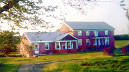
Christian's barn and house were frequently used as the meeting place of the group. This was particularly true following his construction of a large house made of bricks from the clay nearby Forks Creek. Situated approximately mid-way between the Bertie group and the congregation that developed later to the west, the building became known as the "Half-way House." The house remains in the family. Later, in 1881, the Wainfleet group constructed a meeting-house on land across the road to the east of the Half-way House on property leased by Henry Wills. The lumber for the building came from trees on Christian's land - donated, as was his labour.
Christian died four years after the building was completed. His wife Barbara survived him for fifteen years. She, too, was a devout Christian, in Tunker fashion. In 1893 her young daughter-in-law Anna, wife of the junior Christian, reported in the Evangelical Visitor that "aged Mother Sider" had requested a service in her room. A group met with her on a Sunday afternoon, where "saints were revived and the unsaved convicted of sin and some that had fallen back renewed their covenant with God."
Christian and Barbara had thirteen children, three of whom died in infancy. Joseph, the oldest son, became as deacon (fortunately for the congregation he had managed to escape a pack of wolves while walking to Bertie to court the young woman who would later become his wife.) The youngest son Christian served for a period of time in the Wainfleet ministry. Their second son, John, became the group's leader following the death of his father in 1855.
The leadership qualities that John displayed before his conversion in community youth circles continued in evidence afterward. He was elected to the ministry at the age of twenty-five. He and his wife Mary Ann (Climenhaga) entertained many people from both the church and the community, including among the poor; as a result he was frequently asked to preach funeral sermons for non-Tunkers. "John Sider," he once reported himself as saying, "you must be preaching too many smooth sermons! Asking God for special guidance at the next funeral, I used for a text, "If the righteous scarcely be saved, where shall the ungodly and sinner appear?" He was not asked to preach a funeral sermon for some time after that forthright declaration.
Given John Sider's reputation in the community, it is suprising that any credence should have been given to a rumour that he was cheating the local (Winger) cheese manufacturer. "A report has got widespread circulation," the manufacturer, E. Ginther, protested to the editor of the local paper, "that John Sider, John Forrester, and P. J. Wilson were among those charged with watering milk sent to the Forks Road cheese factory. I, as cheese maker.....for the past five years feel it is my duty to contradict the slanderous report. No such charges has (sic) ever been made against any of those parties." The episode obviously did no permanent damage to Sider's image; still even the rumour must have been troublesome to a man and a group of people who prided themselves on living on the highest moral level.
As the above suggests, John Sider was one of the leading Tunker speakers of his day. He also had firm opinions; one could tell when he was disagreeing with someone, such as a preacher delivering a sermon, by the manner in which his chin jutted out, causing his beard to rise in a horizontal fashion.
From its beginning, the Wainfleet members remained under the supervision of the bishop living in Bertie Township, thus Wainfleet was part of the Black Creek District. In 1910, however, the district was divided into the East End and the West End, with Wainfleet and the congregation that had appeared still further to the west forming the West End. John Sider was elected bishop in this part of the district. Not until 1927, however, did the West End become entirely separate from the Black Creek District. The new district took the name Wainfleet, which it had earlier been more informally called.
For most of the nineteenth century, the membership at Wainfleet remained relatively small. The forty-one persons listed as Tunkers in the township in the 1841 census seems a little high, especially since the early move of the Siders and others from Bertie had not been completed at that date. One source notes that by 1881, when the church was built, the membership was around thirty; another source suggests that in 1895 it was around twenty, although this seems a little low. Two years later, in reporting a love feast, the Wainfleet correspondent to the church paper noted that some 300 ate supper but the number was greatly reduced when it came to feet washing (which only members could practice). In the 1891 census, 118 people were designated as Tunkers.
From "Two Hundred Years With The Siders" compiled by Harold and Ron Sider -
Both Christian and Barbara were born in Bertie Township, although Barbara was born into a Mennonite family who lived in a log cabin about two miles south of the Sider home. After their marriage they both united with the Tunker Church and moved to Wainfleet Township to make their home there. Christian's original land was along the Forks Road, on the south half of Lot 30, Concession 5. Here he cleared the forest and built his first house out of logs.
In 1845 Christian was ordained to the ministry of the Tunker Church, becoming the first minister in the Wainfleet congregation. His preaching was in German, and his training was in the "school of experience."
In 1859 Christian built a large brick house on this property, the bricks being made from clay taken from the Forks Creek that ran through the farm. This house, still in use by Christian's descendants, was built with two large rooms for holding church services.
Christian later purchased the north half of Lot 29, Concession 5, and still later acquired the north half of Lot 30, Concession 5, from his brother John. He was a successful farmer, but also a faithful churchman.
Christian Cider was married to Barbara Sherk by John Anderson at Fort Erie on April 12, 1842. Witnesses were Andrew Sherk and Daniel Fretz.
|
 Rainham Builders
 1817 - 1885 (68 years)