| Notes |
- Evangelical Visitor
March 1, 1904
Elder Abraham Winger.
In our obituary column appears the notice of the death of another of the elders of the church. Though the elder whose name is at the head of this article was not so extensively known as the late Elder Zook and others, yet for many years, though in a smaller circle, Walpole Winger, as he was familiarly known, was a familiar figure, particularly throughout the Canada districts. Our acquaintance with him dates back to 1874 when he was yet an active worker in the vineyard of the Lord. He was considered an able, forceful speaker with a fund of anecdotes and illustrations at his command that always gave interest to his discourse. He traveled extensively in Canada, usually regularly making the round of the Love feasts twice a year. Outside of Canada he visited Pennsylvania, Ohio, Kansas, Michigan and other States on Conference occasions. He spent much time and not a little money in the interest of the church and the Master?s work and service.
As stated in the obituary he was in his early years a class leader in the Evangelical Church and was acquainted with the early preachers and bishops of that church, among them the noted Bishop Seibert. His reminiscences of those early days were interesting to a later generation. It is well known that those early preachers were severely plain in their apparel, and with sorrow saw the younger generation of preachers depart from the pious simplicity of former days. Among other thin,gs we recollect him relating how that at a certain campmeeting the fact that pride was making such inroads into the church was under consideration by the ministers present,questioning what could be done to correct the evil. Failing to arrive at a satisfactory solution they said let us ask father, one of the old ministers who happened to be present. When they asked him he answered, ?Yes, I can tell you the remedy, commence with the preachers and get them to put away their pride.? They did not inquire of him any further, as it hit the nail on the head.
His active work in the ministry ceased a number of years ago, but now he has gone to his reward like a well-ripened shock of corn. Thus one by one those who laboured assiduously and faithfully during a former generation are passing away from among us. We may well ask, on whom shall their mantle fall? May there always be such found who shall step into the place and serve faithfully their day and generation until the Master come to reward his servants.
WINGER.?Died, on February 13, 1904. of old age, Elder Abraham Winger, of Springvale, Haldemand county, Ont., aged 82 years and 24 days, Brother Winger was with the Brethren in the ministry about 54 years, after being class leader with the Evangelical Church manny years in earlier life. He proved to the Brethren Church a powerful speaker, and an efficient worker in the faith of the church, and travelled a great deal throughout the Brotherhood especially in time of Lovefeasts. He was an officiating elder many years. His side companion preceded him to the beyond just mile years. His life was spent on the old homestead where he settled with his family in the woods in early life, and now occupied by his son Solomon and family who cared for him in his declining years. He leaves six sons (two in the ministry) and two daughters, with many grandchildren to mourn, their loss. Funeral was largely attended at the house on Tuesday afternoon, February 16th, conducted by A. Bearss from Psa. xcii. 12 - 15. Interment in the Springvale cemetery on his farm.
- From "The Brethern in Christ in Canada" by E. Morris Sider -
Nearly at the same time that the Siders were moving to Wainfleet, a few Tunkers were moving some forty kilometers (twenty-five miles) west of Winger into Rainham Township, Haldimand County, in the Fisherville-Kohler area. They were mainly Winger families from Bertie Township. The date of their arrival is not known. A petition to the government in 1832 from Haldimand, Rainham and Walpole concerning Indian land bears the signature, among others, of Benjamin Winger, but this seems too early for Tunker settlement in the area. However, four Winger brothers - Jacob, David, Abraham and John (called "Honey John" because he kept bees) did move to Rainham in the early 1840s (their father, according to a family tradition, made the mistake of taking saltpetre instead of salts and died as a relatively young man, leaving, besides a widow, four sons and a daughter). At least one of these brothers must have moved to Rainham by 1841, for the census for that year shows four Tunkers in the township. Abraham, according to an obituary, came to Rainham on his marriage in 1841.
The group at Rainham remained small, made up almost entirely of Wingers. At least one of the brothers, Abraham, moved again after a few years. The other Wingers do not appear to have been enthusiastic Tunkers. Services were not regularly held until 1868 when "Honey John's" son Benjamin married Anna Sider, daughter of Christian Sider, Sr., minister at Wainfleet and the couple opened their house to both members and community. The census figures are illustrative in the 1851 census, two Wingers - David and Jacob - do not claim affiliation with the Tunkers, while two other Winger families do. The 1871 census lists thirteen who claim to be Tunkers. By 1891 this figure has grown to thirty-four.
The increase reflected by this last census figure was owing in part to the all-too-brief but enthusiastic leadership of John W. Hoover of South Cayuga, who, after conversion, had afiliated with the Rainham group. It was owing in part to several effective revivalistic campaigns , at least one of which was conducted by Hoover himself. Following such campaigns in 1887 and 1888, seven people were added to the group, although most of these were Wingers, including David Winger and his wife who had not claimed Tunker status in the 1851 census. Hoover reported in the church paper (The Evangelical Visitor) two occasions during these two years when members met in the Mennonite Church at Hoover's Point to examine applicants and to baptize them in nearby Lake Erie. Encouraged by the revival meeting in 1887, the members bought a church building near Kohler, abandoned by the Primitive Methodists. Three years later, in another revival meeting under evangelist, J. R. Zook, more conversions occurred, although again primarily among the Wingers themselves.
Organized congregational life, however, disappeared by the late 1920s. In part this was owing to the very conservative nature of the group, which discouraged people from joining them, and led some of their own number to join other groups, such as the Evangelical Church. Still others moved from the area. The problem was also one of leadership. John Hoover and his wife Harriet left the congregation for a career in missions and evangelism. John Winger was not an entirely satisfactory replacement. He resigned from the ministry in 1910, in part because he refused to give up his life-long practice of chewing tobacco, in part because he refused to submit to the doctrinal examination being required of ministers in those years (according to some accounts he also refused because he did not believe in the teaching on holiness that had become part of the official doctrine of the church). Despite attempts at persuasion by district officials, Winger remained adamant in his decision. Other ministers from the district, most notably John Nigh, for a number of years, conducted services for the group, until the few remaining members decided to join the new congregation that in the 1920s was emerging at Cheapside, about ten kilometres (six miles) to the west.
Abraham Winger, one of the four brothers who had moved to Rainham in the early 1840s, in 1844 decided to settle permanently some forty kilometres (twenty-five miles) to the west in Walpole Township, near what is now the village of Springvale. With Abraham, his wife Elizabeth, and two children (born in Rainham) went Christian Shoup, who built the first sawmill in the area. They were among the first settlers in the township.
The sawmill is suggestive of the state of the Walpole countryside in the mid 1840s. The writer of one of Abraham's obituaries in 1904 described Walpole in those days as a "trackless forest" which Abraham, "possessed of a hearty constitution, young and ambitious," proceeded to conquer. He was "foremost in the work of road making" and helped "to chop a road" from Hagersville to Springvale, a distance of eight kilometres (five miles).
Apparently Abraham was not at first associated with the Tunkers, whether from design or from being separated from other Tunkers is not clear. George Detwiler, who knew him well (they first met in 1874), wrote at the time of Winger's death that Abraham had been a class leader in the Evangelical Church and was acquainted with the early preachers and bishops of that group. (In the 1851 census he is listed as Methodist, by which the Evangelical Church was popularly known.) Clearly he was not a Tunker in that year.
But he became one in the next few years. He is listed as such in the 1861 census, and two other sources (although differing in dates) maintain that his ministry began in the 1850s. Thus the Tunkers at Springvale may be said to date back to the 1850s.
By all accounts Abraham was a strong leader. Detwiler described him as "an able, forceful speaker with a fund of anecdotes and illustrations at his command that always gave interest to his discourse." A popular saying among the Tunkers in Canada was that if Abraham Winger and John Hoover were present at a love feast, no other preacher was needed. He was clearly in demand in the Canadian congregations; Detwiler relates that Abraham regularly made the round of love feasts twice a year, and visited Pennsylvania, Ohio, Kansas, Michigan and other states. His popularity may explain his nickname: he was called "Walpole Abraham" (in reference to his location in Walpole Township) to distinguish him from the bishop of the same name at Bertie.
Despite "Walpole" Abraham's strong personality and powers of preaching, the group at Springvale remained small. The 1861 census records twenty-five Tunkers (including all persons in a Tunker family), the 1891 fifty.
Among families other than Abraham's was John Winger's. John was the son of "Honey John" of Rainham (Abraham's nephew). While not a member of the church until later in life, his wife and children were (his daughter Fidella married John Nigh, in later years Springvale's minister. A farmer, John knew the folk-like remedies of his day, such as curing earache by placing the bowl of his pipe against the afflicted ear and blowing tobacco smoke into it. George Weidrich and his family were also members. A native of Germany, he married Susannah Sider of Bertie; they moved to Springvale in 1854. Weidrich's health and financial problems were a long-standing concern to the congregation and to the Black Creek District, which seem always to have been considering how best to assist him.
The members and their families at Springvale first held their services in Abraham's house. In 1874 they purchased the Wesleyan Methodist church south of the village (they called the building Zion meetinghouse). Later, in 1904, Abraham's son Christian, also a minister as well as a building contractor, led the group in constructing a "plain, neat, sufficiently commodious meetinghouse," still in use.
From Fisherville Trinity Lutheran Cemetery Book:
WINGER
The Wingers who settled in Rainham and Walpole, coming here from Bertie Township, Welland County area, were all children of Abraham Winger and Catherine Troup (daughter of John Troup). They were of the Tunkard faith. They had 8 known children: Jacob (md. Elizabeth Benner, Elizabeth Smelser), Esther, David (md. Margaret Baxter), Abraham (md. Elizabeth Shoup), John (md. Elizabeth Johnston), and Peter (md Abigail Shoup). The Canada Company purchased a lot of land in Rainham from the Crown around 1837. Benjamin Troup, a cousin [should say brother] of Catherine Troup, and his wife Magdalena bought 400 acres from the Canada Company in 1847, being lots 5 and 6, concession 4, Rainham. They almost immediately turned the land over to Abraham Winger N ½ and Jacob Winger S ½. The Wingers discovered, however, that there were three families (Ullman, Nauman, Sitter) firmly entrenched on this property, having settled there in the mid 1830s while it was still Crown Land. The Wingers arranged to sell the property to these settlers. The Sitters on the N ½ , and John Nauman on the SW ¼ paid for their property in 1850, and Jacob Ullman on the SE ¼ signed a bond to purchase and pay for the land as soon as he had the money. This did not happen until 1863 when Jacob's son Benjamin finally paid for the property and quit claimed the farm over to his father all except for 2 acres sold to his brother-in-law Peter Phillips. So, technically, Jacob Ullman's SE ¼ farm was owned by Jacob Winger. He was the one who sold in 1849 the ½ acre lot to the Trustees of the Evangelical Church of German and Dutch (where Trinity cemetery is located) on land where Jacob Ullman had already established a family burial plot and where he allowed other burials to take place. By the wording on the 1849 deed, it is thought Jacob Ullman may also have allowed a small church, possibly a Union Church, to be built earlier on this property. Likely sometime after 1849, the first all Lutheran Church (Holy Ghost) was built on this site, a board and batten structure.
|
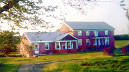 Rainham Builders
 1822 - 1904 (82 years)