| Notes |
Obituary
Mrs. John Dunmead
On Monday 14th inst. a large number of relatives and friends gathered at the Disciples' House of Worship in Selkirk to pay their last respects to the remains of Mrs. Mary Dunmead, who departed this life on the 11th. She was born March 28, 1796, in the Township of Clinton near Beamsville, Ontario, and was nearly 96 years old. We presume she was the oldest citizen of the County of Haldimand. She descended from Irish and Scotch parentage and seemed to have inherited the vigor and courage of both races. She lived contemporaneously with Lieutenant Governor John Graves Simcoe, who summoned the first Provincial Parliament of the old province of Upper Canada, and so her life spans every Parliament of this province. Among the first recollections of pioneer life was the murder of a Mr. Overholt, by the Indians, while taking a fat hog to sell to the Commissariat. During the War of 1812 on another occasion an Indian came into the home of Mr. James Henry, where she was alone, when she escaped by the rear door, gave the alarm, and Mr. Henry's son arrived in time to unhorse the Indian and recover the money. During the War of 1812-14 she assisted the Commissariat on many occasions in provisioning the troops as they passed from point to point. She first met Mr. John Dunmead whose wife she later became as he was locked up as a prisoner of war in an old house on the Niagara Frontier and risked her life in letting him out. She had a personal knowledge of General Brock and the Battle of Queenston Heights, her husband being a young man in the service carrying dispatches. On July 14th, 1815, the night of the Battle of Lundy's Lane, she saved her husband's life. Her married life extended over a period of 61 years and her issue was ten children only four surviving at her death. During the Rebellion of 1837, while her husband was at the front, she nobly cared for her large family. It was her privilege to see the fifth generation in her own family and to enjoy an almost uninterrupted good health. It could not be said that she died of any disease, but like the clock that is wound, ran her appointed time and stopped on as short notice. Early in life she embraced religion as a Methodist and we believe her sympathy continued with them until her demise. Rev. J. Wright, Methodist Pastor, preached a very appropriate sermon. The deceased had many friends among the oldest settlers as well as among their children and her own.
* The origin of this Obituary, handed down from generation to generation, is believed to be the Dunnville Gazette, a newspaper no longer in existence. A similar handwritten undated copy is located in the Selkirk Public Library, and another handwritten copy was among the papers of Hettie L. Weaver. Its date is estimated to be 1891.
From "Samuel Fry the Weaver" by Barbara Coffman:
A few nights later Amos came running home with the news that Abe Overholt was dead, shot by an Indian - shot by an Indian.
"An Indian?" exclaimed Elizabeth. "Why the Indians around here never harm anybody. How do they know who did it?"
"Abe said so. He wasn't quite dead when someone found him on the roadside. He just whispered the word Indian!"
"That's bad business," said Father Fry when he heard it. "We can't have trouble with our Indians. We've always been friends. Guess I'd better go down to Jacob Moyer's and see what we should do."
Returning later that evening Fry reported that a few weeks earlier Overholt had insulted an Indian woman by striking her with his whip when she unknowingly frightened his horse. The shooting, no doubt, was a form of retribution. Moyer sincerely hoped there would be no trouble over the incident.
Poem Written for Mary Ross Dunmead
by Great Great Granddaughter Hettie Laura Weaver
GRANNY DUNMEAD
Granny Dunmead's name at first
Was Mary Ross, I'm told,
Before she married Grandad
A soldier brave and bold.
Dispatches Grandad carried
For Isaac Brock, they tell,
And near him in the battle
Saw when that hero fell.
Granny's house was built of logs
And had a fireplace too
Where she could do her cooking
And sit when work was through.
At night time Granny's house was lit
By tallow candle light,
She was afraid of coal oil lamps
Though they were much more bright.
When she was old and wrinkled
And Grandad passed away
In winters with her children
Would Granny come and stay.
But the Irish that was in her
Was Granny proud to own
And always on St. Patrick's Day
Went back to her own home.
Although I never saw her
Yet I delight to hear
About the things that Granny did
While she was living here.
|
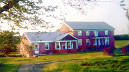 Rainham Builders
 1796 - 1891 (95 years)