| Rainham Settlement
|
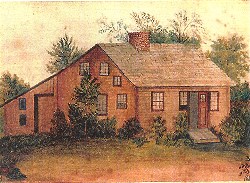 | Jacob and Elizabeth Hoover's Place, Lakeshore Road
Built in 1823, evidently by David and Elizabeth (Stoner) Hoover, possibly as a "Daadihaus" (retirement house) this small place stood next to Lake Erie for over 180 years. Jacob and Elizabeth (Brick) Hoover lived in this place in their declining years. During the late 1900s Art and Mary (Hoover) Dawson lived in this place, and many valuable records were stashed in Mary's front sun porch. |
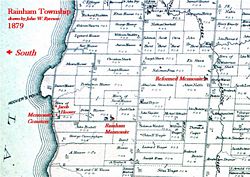 | Site of Jacob and Elizabeth Hoover's Home along Lakeshore Road Site of Jacob and Elizabeth Hoover's Home along Lakeshore Road
Jacob and Elizabeth's oldest son, Daniel, lived in the main farmhouse a short distance to the west, on Hoover's Point. Later Daniel built a new house and barn on the north side of the new road. You may notice on this map how the old Lakeshore Road skirted the south side of the Mennonite Cemetery and the Jacob Hoover residence. |
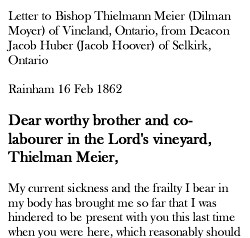 | Jacob Hoover's Letter to Bishop Thielmann Meier (Dilman Moyer), 1862
In the mid-1800s Mennonite families of the Niagara District -- the Rainham congregation includes -- suffered a sharp identity crisis. All around them Protestants experienced glorious revivals and the mission emphasis took young men and women from Canada-West (now southern Ontario) to foreign fields far and wide. Many young Mennonites felt restless. In the Moyer congregation at Vineland Bishop Jacob Gross and minister Daniel Hoch led numerous families into "born again" fellowships where prayer and camp meetings attracted crowds from all denominations. Both Thielmann Meier and Jacob Hoover of Rainham shared deep concern and common distress on what was happening.
What good can come out of confusion? Out of worldliness, or careless living?
What happens when humility, nonconformity and obedience give way to religious emotionalism?
Jacob Hoover prayed much (see his obituary below), and not without reason. Of his eleven children, only three "stayed plain" (Daniel, Peter and Lydia). And the rest of them, inspired by the great revivals, all found their way into main-stream Canadian society.
Jacob wrote this letter in German, but it was later translated to English by Peter Boschart, an Amish-Mennonite brother from Milverton, Ontario, for the Rainham Mennonite Minister, A. Lewis Fretz. |
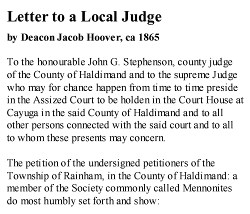 | Jacob Hoover's Letter to a Local Judge
Obviously Jacob Hoover, who wrote and spoke German fluently, worked with a scribe, somewhere, to write up this letter for the local Court at Cayuga, Ontario. His Christian conviction, speaking for the Rainham Mennonite Congregation, stands squarely on Early Christian and Anabaptist belief. |
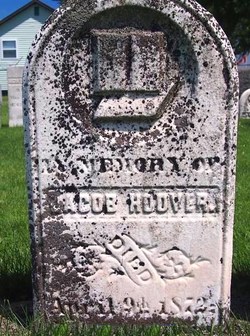 | Jacob Hoover Grave Marker
Buried in the Rainham Mennonite Cemetery along Lake Erie, Jacob's simple marker states:
JACOB HOOVER
died
February 6, 1810
In the 67th year
of his age
Not much to say on this side of eternity. But what a joy to look forward to meeting Jacob "in new heavens and a new earth where righteousness will dwell!" |
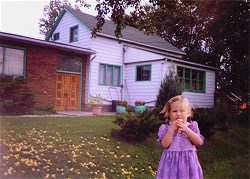 | Jacob and Elizabeth Hoover's House, 1999
The old house still visible, although modified. Mary Dawson's desk behind the sun porch windows. The little girl enjoying the abundant pears is Stefania Hoover, daughter of Peter and Susan, just before she moved to southern Chile, in South America. |
 Rainham Builders
 1806 - 1872 (66 years)
 , d. 24 Sep 1846, Rainham Township, Haldimand County, Ontario